
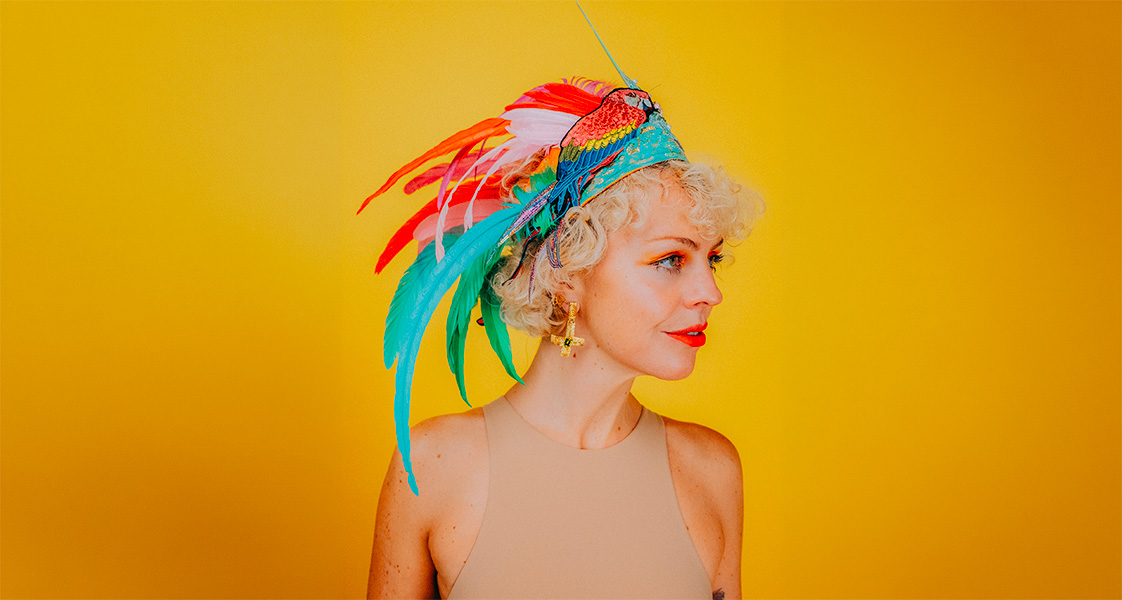
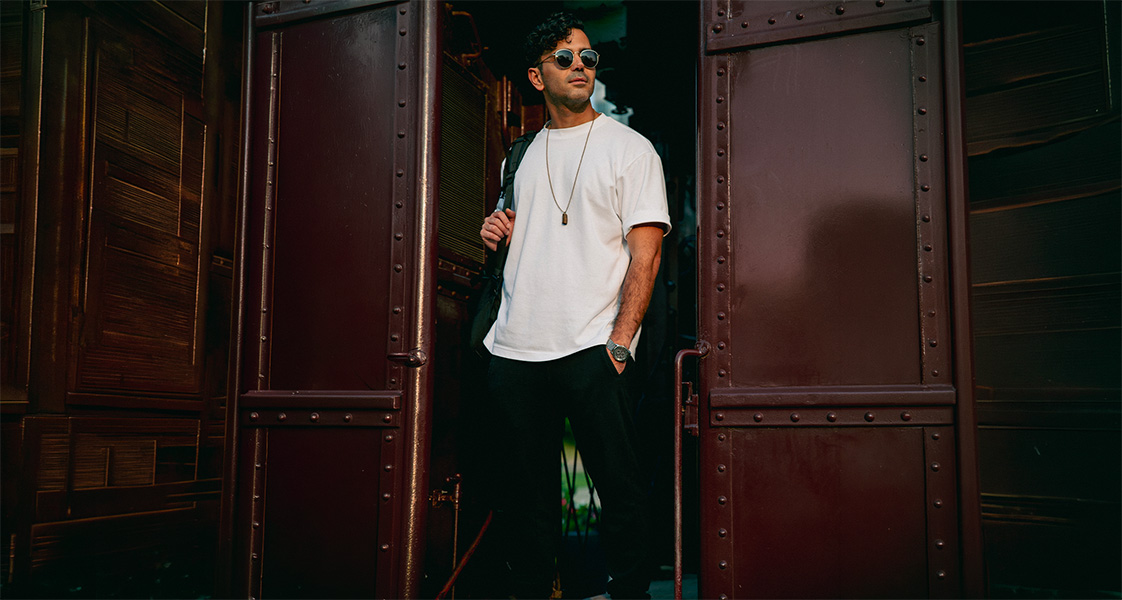
Philippa has long been a quietly influential force in Berlin’s electronic music landscape — a producer whose work balances emotional depth, harmonic richness and dancefloor intuition. With the launch of her new label, Panther Cuts, she steps into a new chapter of creative autonomy. We caught up with her to talk evolution, process, collaboration and the realities of making music today.
WWD: Your creative evolution — how has your relationship to harmony, groove and texture changed over the last decade of producing in Berlin?
For me, harmony is probably the most important part of the composition, and it’s usually where I start. I’ll often find a mood or emotional direction through a set of chords before anything else.
If anything, my relationship to harmony has deepened. Harmony is a bit like the film Inception — the deeper you fall through the layers of consciousness, the more you discover. It’s a never-ending labyrinth, and one I’m happy to get lost in.
WWD: What internal shift or realisation made you feel ready to launch your own label rather than continue releasing solely through established imprints?
I’ve been writing a lot of music lately, but much of it hasn’t been for broad public consumption. I have a Bandcamp-only series called Quiet Fire, which is quite niche in scope, and I’m currently writing an album for a publisher that won’t be widely released either.
At some point I realised I wanted to put some of this music out properly, and rather than waiting for another label’s release schedule to align, I decided to release it through Panther Cuts.
That said, I absolutely love releasing on labels like Freerange, SlothBoogie, Local Talk and Lazy Days, and it’s a real privilege to work with them.
WWD: What does the twotrack format allow you to express artistically that a traditional EP structure doesn’t?
The biggest advantage is pace. A two-track release means a quicker turnaround, which suits where I am creatively at the moment.
WWD: What emotional states or internal landscapes were you trying to capture with ‘Motion State?’
I’m actually not trying to capture anything specific when I write. The music that comes out is simply what comes out. To me, tracks seem to have a life of their own and an idea of what they want to be, and my job is really just to protect that as they come into the world.
Obviously I’m choosing the sound sources and instrumentation — but I don’t sit down thinking, “today I’m going to write this particular style of record,” or try to manufacture a specific emotional response. I try to stay open and let the music reveal itself.
I’ve generally found that when the process is controlled too much, inspiration becomes evasive. So I try to respect that, get out of the way, and let the music arrive as it arrives.
WWD: What qualities in Séna’s musicianship made her the right collaborator for this project, and how did her presence reshape the track?
Séna is an electronic music producer in her own right and also a former student of mine at Catalyst in Berlin (Institute of Creative Arts and Technology), where she recently completed her BA (Hons). Alongside that, she’s a very experienced performer with well-developed jazz and soul instincts.
I’ve always admired the tonal quality of her voice and her phrasing — her voice has this beautifully sultry quality to it.
More broadly, I’m really interested in discovering and bringing new voices into the realm of house music. There are so many incredible vocalists out there, and it’s exciting to help introduce them to a different audience.
WWD: How do you decide when a sound needs to come from analogue synthesis, live instrumentation, or digital processing?
I’ve talked about this in a lot of interviews recently. I’ve also been discussing it with students and debating it with other musicians and academics. Everyone seems to have strong opinions, but for me personally, the digital realm is underwhelming.
It’s useful in terms of fast, flexible tools we can dial up, but it’s not something I want to use as a primary sound source. To my ears, it can sound quite flat.
For example, if you record an analogue synthesizer playing the same note repeatedly and zoom in on the waveform, every note will look slightly different because of natural variations in the circuitry. If you do the same with a digital VST, the waveform is reproduced identically every time. It feels stamped rather than alive.
That doesn’t mean I’m a purist. I heavily favour analogue sound architecture, but I still use digital processing and software instruments where they make sense. And of course, there are incredible producers making predominantly digital records — so this isn’t an anti-digital manifesto. But given the choice, I personally favour analogue circuitry.
WWD: Your academic research explored sound as a tool for immersive or transcendent states. How does that research manifest in your current production work?
The connection is less direct than people might expect. Academic research and creative practice are related, but in the studio, instinct tends to lead the way.
WWD: What patterns do you observe in emerging producers today, and how does teaching inform your own creative discipline?
Teaching keeps me immersed in music all day, every day. I’m constantly talking about music, reading, researching, listening to students’ work and giving feedback, and it’s a rewarding environment to be in. I feel incredibly grateful that this is what I get to do.
As for emerging producers, it’s almost impossible to generalise because the range is so broad — students are making everything from experimental sound art to full-blown techno and electronic pop.
What consistently impresses me is the level of thought and creativity that goes into the work. There are some incredibly talented people coming through, and I feel privileged to hear what they’re making.
The biggest challenge isn’t a lack of ideas or ability — it’s the current economic reality of the industry. There’s a huge amount of excellent music being created, but getting it heard and building a sustainable career around it has become increasingly difficult.
WWD: Do you have any personal rituals, habits or constraints that help you enter a productive creative state?
I’m a big believer that inspiration follows action. Or, as Rich Roll says, “mood follows action, people”.
There isn’t really a secret ritual — it’s about spending time in the studio. The more time I spend in the producer’s seat, the more likely I am to find something interesting. I genuinely believe that the act of making music puts you into a creative state, rather than waiting to feel creative before you begin.
WWD: As the label evolves, what boundaries do you hope to push — sonically, conceptually, or structurally?
I just want to keep writing good music and stay open to wherever the process leads. I’ve found that the less I try to force an outcome, the better the records tend to be.
WWD: Wise words! Thanks for the chat 🙂
Thanks for having me, WWD! x
‘Panther Cuts Vol.1’ is available here